Five years after it was introduced, the City Council passed a revised version of the Community Opportunity to Purchase Act, or COPA, which supporters say will give mission-driven groups a leg up when affordable and distressed buildings come up for sale. Critics say it’s government overreach.
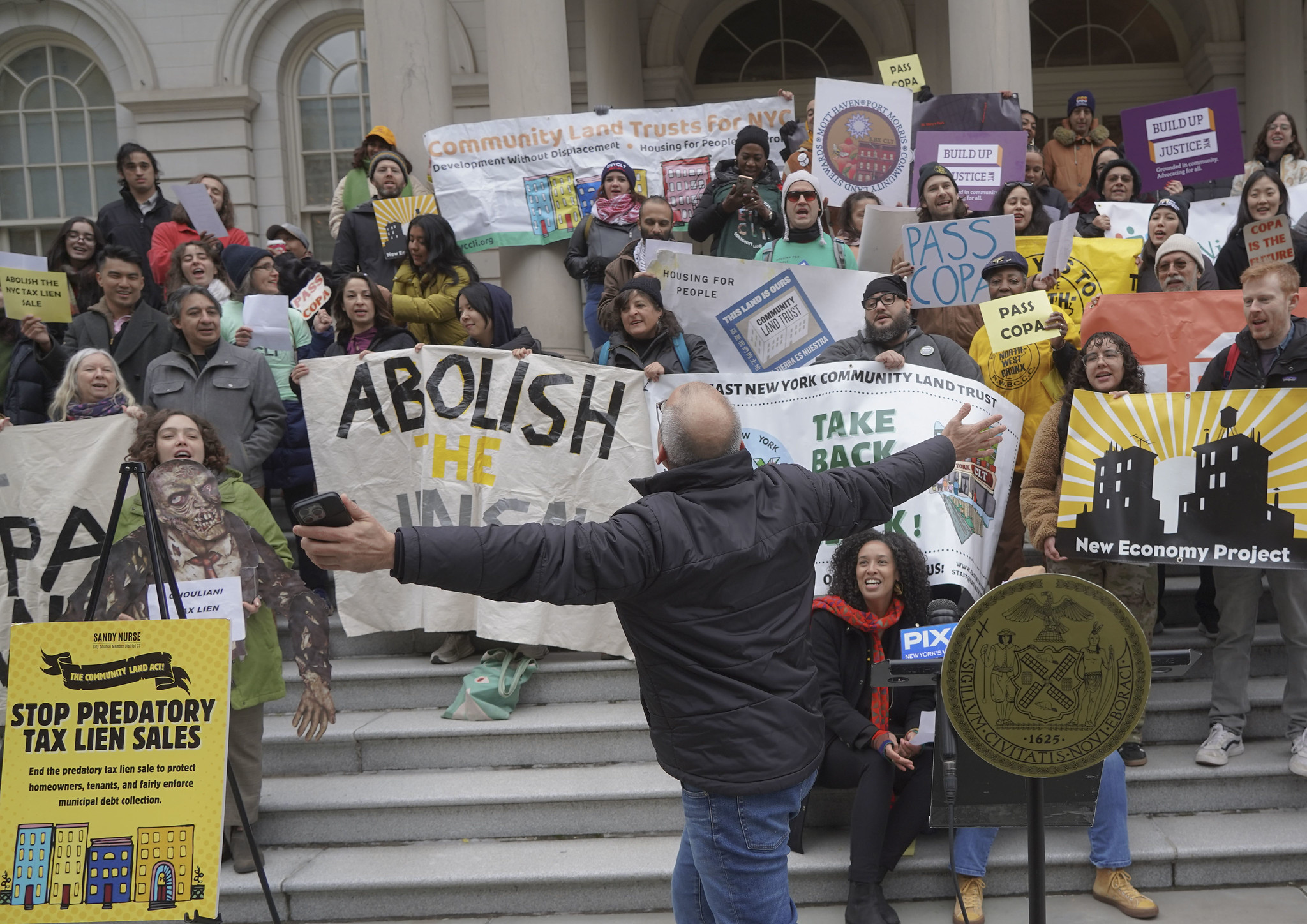
Five years after it was introduced, the City Council on Thursday passed a revised version of the Community Opportunity to Purchase Act, or COPA, which will give certain nonprofits—and for-profits, if they team up with a nonprofit—an early shot to bid on certain residential properties that go up for sale, before they hit the wider market.
Landlord and real estate groups have criticized the legislation as government overreach. But supporters say COPA will give mission-driven groups, including community land trusts, a leg up against deep-pocketed real estate speculators in the city’s competitive housing market.
Modeled after a similar bill in San Francisco, it specifically targets buildings with poor conditions or where an affordability provision is expiring. In those situations, lawmakers said, COPA can serve as a preservation tool, allowing a “qualified entity” to come in and, with the help of other city programs, right the ship—making repairs, maintaining affordable rents—ideally in coordination with the tenants who live there.
“We want to try to keep those units affordable. This is an opportunity to do that,” Councilmember Sandy Nurse, who sponsored the latest version of the legislation, said in a press conference Thursday. Without COPA, she said, “we potentially lose those affordable units.”
(function(d,u,ac){var s=d.createElement(‘script’);s.type=’text/javascript’;s.src=’https://a.omappapi.com/app/js/api.min.js’;s.async=true;s.dataset.user=u;s.dataset.campaign=ac;d.getElementsByTagName(‘head’)[0].appendChild(s);})(document,54625,’u4kmqsczew4vunxutxmd’);
The bill passed by lawmakers underwent a number of revisions since COPA was originally introduced in 2020, a response to concerns raised by both property owner groups and the city’s Department of Housing, Preservation and Development (HPD) that it would delay sales too dramatically and could burden small landlords.
The revamped version narrowed the types of buildings covered by the legislation, and exempts small properties. It also created more specific criteria for what kind of nonprofits would qualify to make an early bid, and shortened the window of time they’d have to make an offer.
“What we have before us is a bill that achieves as much consensus from as many stakeholders as possible,” Nurse said ahead of the vote Thursday, which marked the Council’s final meeting of the year and its last chance to pass legislation this session.
But real estate groups have maintained their opposition to COPA, questioning its efficiency and saying it unfairly favors nonprofits at the expense of private property owners. Ahead of the Council vote, the bill’s opponents parked a truck with a digital billboard near City Hall. “COPA makes housing more expensive,” the screen read in bright pink letters. “Corruption. Socialism. Rent Hikes.”

Thursday. (Photo by Todd Baker)
“The amended proposal would still give nonprofits and for-profits leverage, advantages and privileged access through an exclusive months-long window that no ordinary buyer is afforded,” Ann Korchak, board president of the Small Property Owners of New York (SPONY) and Robert Lee, a SPONY member and building owner in Bushwick, said in a joint statement shared with City Limits. “For a small owner in distress trying to sell quickly to avoid liens and foreclosure, the amended scheme still creates serious timing risk that would artificially devalue property.”
How it will work
The revised version of COPA covers a smaller breadth of buildings than originally proposed, rolled out in phases. Properties with fewer than four apartments are exempt, as are owner-occupied buildings with five or fewer units, and vacant lots.
For the first year, impacted properties will include those that have been involved in one of several city initiatives that target very poor building conditions (like the Alternative Enforcement or Certificate of No Harassment programs) for at least a year—what Nurse described as “an extremely targeted universe of properties that we already spend a lot of time and money on trying to make safer.” For the second year, it would expand to buildings in less severe, but still bad shape (at least one open hazardous or immediately hazardous housing violation per apartment).
Also covered: buildings with affordability restrictions set to expire within two years, what officials say could help ensure properties transition to new ownership that will prioritize keeping rents affordable for existing tenants.
Should the owner of one of these types of buildings wish to sell, they’d be required to notify the city and a list of “qualified entities,” to be established by HPD. The law sets a number of benchmarks these groups must meet: they must be nonprofits (or for-profits partnering with a nonprofit), and have demonstrated experience in managing residential properties and preserving affordable housing, among other criteria.
Once these groups are notified of a covered building owner’s plan to sell, they have 25 days to notify the owner and HPD of their interest to purchase, and then 80 days to make an offer, according to the New Economy Project, an advocacy group that’s been campaigning for the bill.
If no qualified groups express interest in those first 25 days, or if the landlord rejects all the qualified buyers’ offers after the 80-day window, the property can go up for sale on the wider market. The first qualified buyer who made an offer, however, has 15 days to exercise a “right of first refusal” and match the terms of any open market offer the landlord is weighing.
The debate
In addition to accusations of government overreach, COPA critics question if shepherding distressed buildings to nonprofit buyers will mean improvements for the people living there.
“COPA does not bring the necessary resources to the table for non-profits to cover their necessary capacity building and upfront costs, let alone funding for acquisition and repairs,” Erica F. Buckley, a real estate attorney and partner at Nixon Peabody LLP, wrote in an op-ed published in City Limits last week.

But supporters say COPA can work in conjunction with existing city programs to address those needs, like Neighborhood Pillars, which provides low-interest loans and tax exemptions for nonprofits and community groups that buy and renovate rent stabilized housing.
They point to previous examples of tenant groups that transitioned their buildings to community ownership models, like the East New York and Cooper Square Community Land Trusts.
The bill offers “an opportunity for nonprofits that we trust, that we fund, that we have a relationship with, that we are holding accountable all the time,” Nurse said.
“Instead of that building being sold to some company with people and investors from all over the world that we have no relationship to, and we have no relationship of accountability to.”
To reach the editor, contact Jeanmarie@citylimits.org
Want to republish this story? Find City Limits’ reprint policy here.
The post Legislation Will Give NYC Nonprofits First Chance to Buy Certain Buildings appeared first on City Limits.

Want more insights? Join Working Title - our career elevating newsletter and get the future of work delivered weekly.
