Competition changes everything. Winning doesn’t hurt, either.
Indiana’s courtship of the Bears and the Hoosier state’s offer to build a stadium for the team has lit a political fire under Gov. J.B. Pritzker and Illinois lawmakers.
Bears President Kevin Warren started playing footsie with Indiana before their playoff run, after claiming he was told by Pritzker and legislative leaders that the Bears stadium quest was “not a priority for 2026.”
Pritzker isn’t saying that anymore.
In fact, the Bears appear to have moved closer to the front of the line as Illinois lawmakers return to Springfield to embark on their spring session.
Pritzker is no longer demanding that the Bears pay off the $532 million in outstanding bonds used to renovate Soldier Field. One of the Bears’ biggest Springfield opponents has also changed his tune on that subject.
Both the governor and State Rep. Kam Buckner, D-Chicago, whose district includes Soldier Field, are also softening their stand on the Bears’ request for $855 million in infrastructure improvements needed to pave the way for construction of a $2 billion stadium on the Arlington International Racecourse site owned by the team.
There’s a subtle but noteworthy change in their tone on infrastructure funding for the 326-acre site and rationalizing that level of assistance by claiming that the same road, mass transit, utility work and other public improvements would be needed whether or not there’s a new stadium on the Arlington racecourse site.
What a difference the construct of a counter-offer from Indiana in the midst of a Cinderella season filled with late-game heroics makes.
Pritzker went out of his way to “disabuse people of that notion” of holding the Bears accountable for Soldier Field debt on Friday, the morning after Indiana lawmakers filed legislation that could pave the way for a new Bears stadium across the state line.
“The financial responsibility for that debt does not fall on the Bears,” Pritzker said at an unrelated South Side press conference. “Having said that, we do not want to leave the city of Chicago or the state of Illinois with an enormous debt that goes unpaid. And so we have to figure out how that happens — that does not fall entirely on the Bears.”
“We’ve been really clear about what we’ve been willing to do as a state, and there have been lots of discussions over time and recently with the Bears to make sure that they know what those options are,” Pritzker said. “I believe it’s best for the Bears to stay in the state of Illinois. I’ve always said that. I do not think the fans want the Chicago Bears to be based anywhere else except in the state of Illinois.”
Signs of hope for a stadium deal in Illinois
Buckner is suddenly hopeful about getting an Illinois deal done after years of Springfield futility by the Bears.
“The conversations that we’ve had in the last few days are better than any of the ones we’ve had in the last year and a half,” he said.
Buckner is a rabid Bears’ fan who was a standout defensive lineman at the University of Illinois.
But he insisted that the Bears’ dramatic turnaround under rookie head coach Ben Johnson has nothing to do with the improving odds on getting a stadium deal done in the Illinois General Assembly.
It has more to do with the Bears finally getting specific about the improvements they need in Arlington Heights, and about how much money in annual property taxes the team is willing to pay.
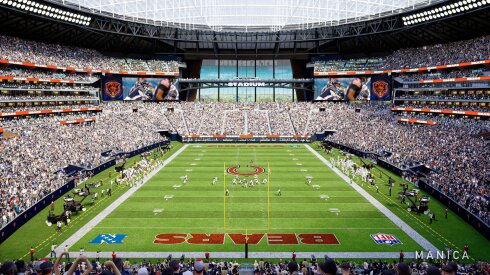
“There have been no actual conversations about how much taxes they’re actually going to pay. We’re asking for numbers. And some of these numbers are now starting to come out… These are not things that we knew or got from the Bears up until this point,” Buckner said.
Legislation filed Thursday in Indiana hinted at what could be on the table for the Bears.
It would empower a newly created Northwest Indiana Stadium Authority to build a stadium for the Bears and sell it to the team for $1 once the 40-year bonds are paid off. The Bears would also have the option to buy the Indiana stadium sooner by retiring the outstanding debt.
In the meantime, the Bears would sign a 35-year lease that would allow the team to retain all revenues generated by the stadium.
That’s a dramatic difference from the revenue sharing arrangement included in the Bears’ Soldier Field lease.
In a statement, Indiana Republican state Sen. Ryan Mishler called his bill “a framework as we continue discussions throughout the rest of the legislative session on the possibility of bringing the Bears to northwest Indiana.” He declined an interview request.
Indiana lawmakers are running a hurry-up offense to land a deal before their legislative session ends in late February. During his “state of the state” address earlier this week, Indiana Gov. Mike Braun said “we are working hard to bring the Chicago Bears to the Hoosier State… Let’s get it across the finish line.”
Arlington Heights also revs up pressure
Arlington Heights officials are trying to ramp up the pressure, too. At a news conference Friday, they urged state lawmakers to advance the so-called mega-development legislation that the Bears are seeking, to allow them to negotiate with local taxing bodies over discounted payments in lieu of property taxes.
“We must stand together as Illinoisans to prevent our State from being out of the NFL business altogether, and support the Mega Projects Bill,” Arlington Heights Mayor Jim Tinaglia wrote in an open letter. “The Chicago Bears should not get special treatment just because they are ‘the Bears,’ but they shouldn’t have it held against them, either.”
Buckner said he’s not concerned about the Indiana offer, even though it appears to be far more than a negotiating ploy.
“Indiana’s legislative session is over in March. They’ll send a salvo across the bow to try to convince the Bears to come there. We have never left the table. We have always told the Bears, `Come back to us with something that makes sense and we can craft what that looks like together.’ They’re just now taking it seriously,” he said.
“We’ll get there. I’m not panicking and I’m not worried about the clock. I think they’ll do the right thing” by staying in Illinois.
Buckner said there may be other ways to pay off the outstanding bonds on Soldier Field or, at the very least, “make sure that we are not left saddled with all of this with nothing to show for it.”
“In Springfield, we can be creative,” he said, refusing to reveal specifics. “There’s got to be a creative way for us to square the circle and land this in a way that everybody gets a little bit of that they need.”
Republicans control the Indiana General Assembly, but it’s a bipartisan campaign, according to Indiana state Rep. Earl Harris Jr., D-East Chicago.
“We know that taxes are going to be easier on this side of the state line. Those negotiations are or will take place in terms of what the state of Indiana is willing to offer and what the Bears are willing to take on this,” Harris said. “It’s just like any other negotiation, whether it’s a sports team or business or political, those conversations will at some point lead to something.”
Harris championed legislation last year that created a Hoosier sports development commission, which he credited with expanding the Bears’ stadium search to now seriously include land in Hammond near Wolf Lake, and near Gary’s Hard Rock Casino.
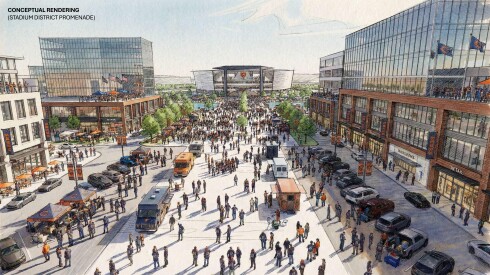
“Northwest Indiana is about the Bears and the Bulls and the White Sox, Cubs, Blackhawks. We are a Chicago sports area. So the fan base is already there,” Harris said. “When you look at what this means for economic development, workforce, opportunities for young people, it really is a great win for both sides, the Bears and Northwest Indiana and the entire state of Indiana.”
Two-state competition for stadium the key
Chicago-based sports marketing consultant Marc Ganis, who has advised numerous NFL teams on their stadium issues, views the Bears’ request for property tax certainty and infrastructure help only in Illinois as “about as one-sided in favor of the government of a stadium deal as we have ever seen in the NFL.”
Ganis is firmly convinced that the two-state competition for the Bears will finally bring an end to the long-running stadium saga.
“They are about to get a plan — probably legislatively-approved by the end of February in Indiana — that will have a significant amount of Indiana tax dollars going into paying for the stadium, unlike in Illinois where there would be no tax dollars going into pay for the stadium,” Ganis said.
Springfield had “better step up quickly or they’re going to be really shocked at how fast” Indiana is prepared to move, Ganis said.
“They’re going to have a really nice offer in Northwest Indiana, which will be a much better deal if they want to take it. And they now have one of the most successful teams in the NFL,” he said.
“Any perception of desperation — any leverage that the state had because the Bears were not playing well and, therefore, didn’t have the fans and the public behind them — [is] all gone.”

Want more insights? Join Working Title - our career elevating newsletter and get the future of work delivered weekly.
