As former Gangster Disciples boss Larry Hoover awaits a hearing this spring over his request for Gov. JB Pritzker to commute his life sentence for murder, influential Chicagoans disagree about whether he should go free.
Late last year, Cook County State’s Attorney Eileen O’Neill Burke sent a letter to the Illinois Prisoner Review Board objecting to Hoover’s first request for executive clemency.
In her Dec. 29 letter, Burke said Chicago’s neighborhoods continue to suffer from extreme violence tied to the Gangster Disciples, the massive street gang that Hoover famously ran from prison.
“Both things can be and are true — that Chicago was ravaged by misguided public policies and disinvestment, and [Hoover] took advantage of the system’s failures and further ravaged Chicago’s neighborhoods due to his creation of the Gangster Disciples and the fostering of violence within the gang,” Burke wrote.
The board is scheduled to hold a hearing on Hoover’s request in April. The board gives a recommendation to Pritzker, who makes the ultimate decision on clemency requests. The board typically takes about two months to forward a recommendation to the governor. A January hearing for Hoover was canceled.
One of 75-year-old Hoover’s high-profile supporters is Arne Duncan, former President Barack Obama’s secretary of education. Duncan now runs Chicago CRED, an anti-violence organization.
In 2023, Duncan sent the Prisoner Review Board a letter supporting Hoover’s separate request for parole, which was denied. The board can grant or deny parole without the governor’s formal input.

In his letter, Duncan told the board he met Hoover’s wife and son and they long to be reunited.
“They have also expressed to me that Larry Hoover would like to see the same thing I hope to see, a safer Chicago. If Larry Hoover is released from his prison sentence, he is more than welcome to help us at Chicago CRED to work to accomplish our mission in reducing gun violence in Chicago,” Duncan wrote.
A spokesperson for Chicago CRED said Duncan now supports Hoover’s pending clemency petition. Other supporters include Chance the Rapper, Jesse Jackson Sr. and the Rev. Al Sharpton, according to his petition.
In her letter to the parole board, Burke outlined the reasons she thinks Hoover doesn’t deserve clemency.
She stressed that she doesn’t think Hoover accepts full responsibility for the 1973 killing of William “Pooky” Young.
Hoover continues to refer to fellow gang member Andrew Howard as the “principal actor” in the shooting, but Hoover was the leader of their gang faction, Burke said. She said Hoover ordered the slaying because he thought Young, 19, was stealing from the gang’s Englewood drug stash houses.
Hoover and Howard were both sentenced to 150-200 years in state prison for Young’s killing. They also were suspected in the fatal shooting of a man who cooperated with Chicago police in the investigation of Young’s murder.
Howard was paroled in 1992, which Hoover’s lawyers say demonstrates the unfairness of the Illinois criminal justice system.
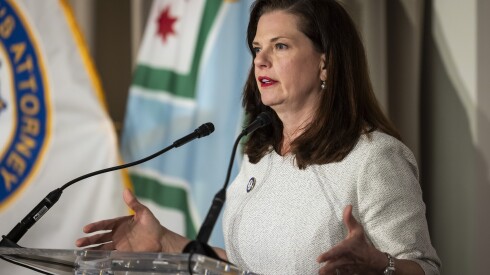
Burke’s objection to clemency for Hoover is a shift in how the Cook County state’s attorney’s office deals with prisoners’ requests for freedom.
In 2021, her predecessor, Kim Foxx, decided she would no longer offer opinions on parole to the Prisoner Review Board after she was criticized for not opposing the bids for release of two men convicted of killing Chicago police officers.
Burke doesn’t weigh in on every parole or clemency case her office is notified about. But she does file objections in some cases, such as a clemency petition for a convicted cop killer last year.
“The Cook County state’s attorney’s office evaluates whether to file an objection to clemency and parole petitions based on the individual circumstances of a case, taking into account the seriousness of the offense, its impact on victims and the risk to public safety,” said a spokesperson for Burke.
Last year, President Donald Trump commuted Hoover’s separate 1997 federal conviction for running a $100 million a year drug operation in Chicago while he was in state prison for his murder conviction. Rapper Kanye West met with Trump in 2018 in the Oval Office to support Hoover’s release. Hoover was freed from a federal super-max prison in Colorado in May.
It’s unclear where Hoover is being held now, but court records last year indicated he was in an unidentified state prison outside of Illinois under an arrangement with the Illinois Department of Corrections.
In recent years, former members of Hoover’s inner circle in the Gangster Disciples have been let out of federal prison under the First Step Act, which Trump signed into law in his first term.
Hoover’s current clemency request is the latest in a long series of his attempts to go free on his state murder conviction. Every few years for decades, the Illinois Prisoner Review Board has denied his requests for parole, a different type of relief from the executive commutation he now seeks.
In the board’s 2022 denial of parole for Hoover, it said his release would “not be in the interest of public safety.”
But in Hoover’s Oct. 22 clemency petition, his lawyers called his continued imprisonment, much of it in solitary confinement, a “slow, state-sanctioned death sentence,” and said he’s renounced his ties to the Gangster Disciples.
“Hoover did not create the fire,” the petition said. “He grew up in it.”
His lawyers said Hoover is now an old man in fragile health who, according to a letter he wrote, wants his legacy to be peace.
“I just want to come home and be with my family,” the petition quoted Hoover as saying. “I am tired.”

Want more insights? Join Working Title - our career elevating newsletter and get the future of work delivered weekly.
