The iconic domes at San Onofre nuclear power plant that have served as landmarks for millions of drivers on Interstate 5 passing through Camp Pendleton for more than four decades will be demolished starting next year, an official at SoCal Edison told NBC 7.
The site came online back in 1967 with Unit 1, which was later demolished. It, too had a dome, though officials called it a “beach ball,” not the term most San Diegans have referred to the pair of cylindrical structures — Units 2 and 3 — that started generating power in ’83 and ’84, respectively. They were retired in June 2013.

Ron Pontes, SoCal Edison’s site-closure manager, has been working on the demolition project since 2014, methodically deconstructing dozens of structures on site. These days, he’s joined by about 350 other people on the project
“Unit 3 will be first, and we anticipate starting deconstruction of the building — of the exterior part of the building — in fourth quarter of 2026, and we think it’s gonna take about eight months to remove the Unit 3 building, and then, once we finish it, Unit 2 should be ready to come down,” Pontes said on Tuesday. “It may even start a little bit earlier.”
Both domes are expected to be completely demolished by mid-2027.
Taking down the domes, which are essentially 4-foot thick concrete structures reinforced with structural steel and rebar — is not as complicated as one might think, Pontes said.
“The way we deconstruct them is use hydraulic hammers … big machines that will hammer away at the concrete on the exterior part of the building,” Pontes said.
The hammers will tool around the building’s base, about 500 feet, until it weakens enough, and gravity kicks in and settles what remains of the building. Then crews will be carting away the debris to a nearby structure — basically a large tent to keep the dust down — that is in the process of being built for that purpose, and will then be pulverized further, then loaded onto capped rail cars and taken to a disposal facility in Clive, Utah.
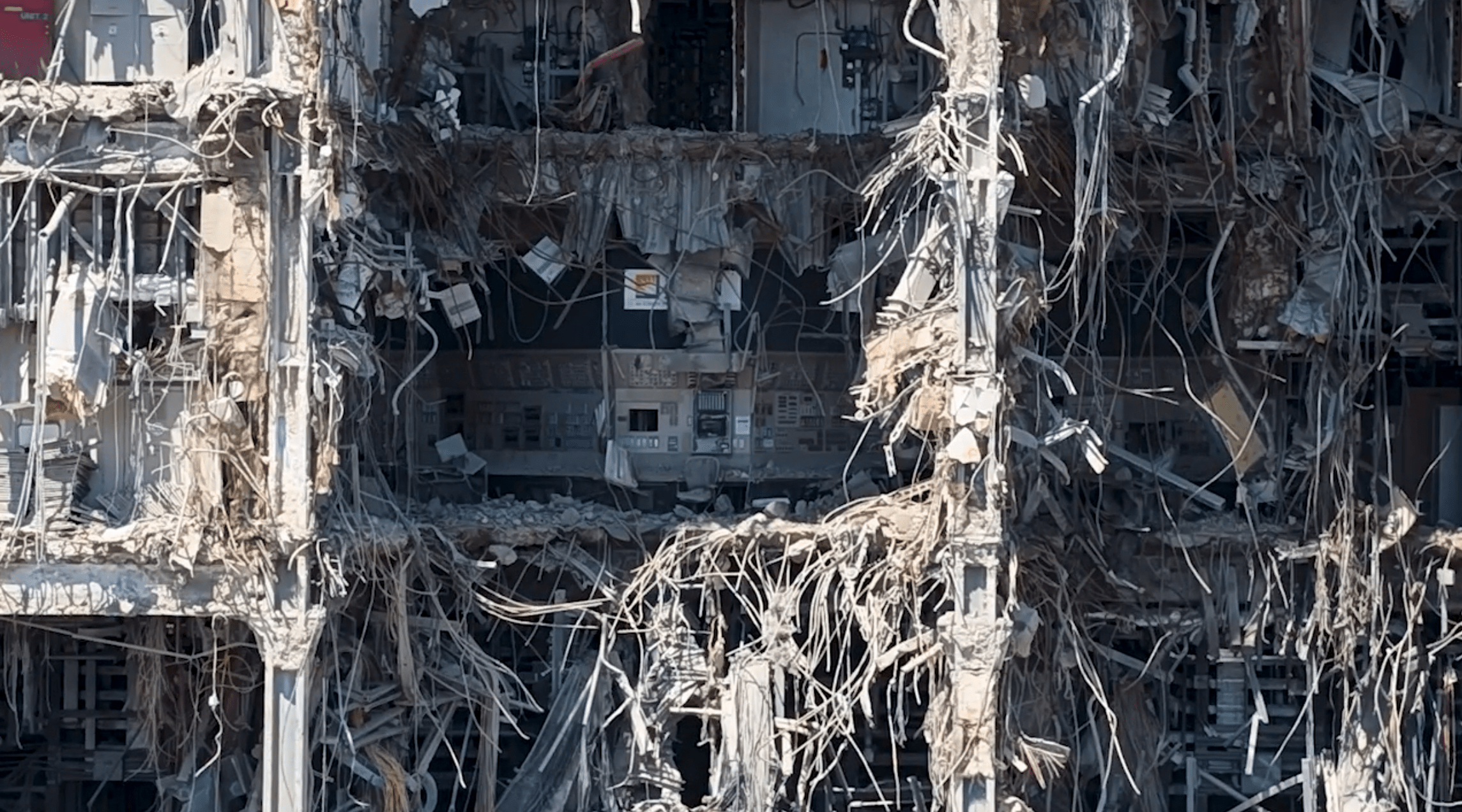
“… the inside of the containment building contains some residual radioactivity in the structures, so we want to control that so we don’t disperse that outside into the environment,” Pontes said, explaining why it was necessary to erect the tent.
Gradually, virtually imperceptibly, the top of the domes will float toward the ground.
“And you just repeat that process over and over, and slowly the building comes down until it’s all gone,” Pontes said, other than the cap, which the excavators will demolish on the ground, making their way from the perimeter to the center.
With this method, the dome generally settles kind of uniformly as it comes down, a technique employed elsewhere, Pontes said, including, most recently, at the Zion Nuclear Power Plant north of Chicago.
Before any of this happens, though — in the next nine months or so — the structures INSIDE the containment building need to be dismantled and demolished.
Once the rubble is loaded onto the rail cars, they will be “surveyed, demonstrated to be clean of any radioactivity,” Pontes said, adding later that they’ve never had to unload a rail car.
“The residual radioactivity that exists in this material is really small, very tiny,” Pontes said. “It’s really hard even to detect.”
When the dust finally settles on the cleared site, Pontes said, they expect to have removed about 1.1 billion pounds of material in about 5,500 rail shipments.
As one might imagine, the demolition comes with a steep price tag, $4.7 billion, which was paid for utility customers in Orange and San Diego counties during the lifetime of the plant, money which was put into a trust till now. Anything left over, Pontes said, would be refunded to ratepayers.
While Pontes won’t be getting a bonus if the project comes in under budget, there are other, less-tangible rewards for his efforts, including his proximity to Trestles, the popular surf spot off the shore of Camp Pendleton.
“I get the bonus of working here right next to San Onofre State Beach,” Pontes said. “I have a beautiful view. When I step out of this office here, I look down over the bluff and there are surfers in the water there every day.”
While the iconic domes will be gone, there is another landmark that some may lament will remain: The towering transmission wires that march across the landscape to the east.
“Well, a number of lines terminate here, so they join here, so the power [flows] across the state,” Pontes said.
With one significant exception, Pontes said, the site will be scraped (three feet down, in fact) and left to return to a natural state in 2028 when the work is done.
“There will be the independent spent-fuel storage installation,” Pontes said, adding, “that’s where the spent fuel from the operation of Units 1, 2 and 3 are stored on-site. That spent nuclear fuel will remain here until the government, the United States government, finds a location for it.”
The radioactive material has been sealed in stainless-steel canisters and housed in reinforced steel-and-concrete structures.
Unfortunately, there’s no plan at this time for its removal.
“That has been a particular problem for our industry because the government has not, you know, delivered on its promise to pick up the spent nuclear fuel,” Pontes said. “They were supposed to start picking up spent fuel from commercial nuclear plants in 1998, and they have not done so.”
The spent-fuel storage area is located to the north of where the domes are now.
Pontes said that, once their work is done, they don’t expect the site and its 84 acres to be open to the public.

Want more insights? Join Working Title - our career elevating newsletter and get the future of work delivered weekly.
