The rolling grounds of the UMLAUF Sculpture Garden and Museum near Austin’s Barton Springs are dotted with bronze pieces, their patinas letting them almost blend in with the scenery. But up close, they’re vividly detailed. A refugee holds a baby in gnarled hands, molded by American artist Charles Umlauf—the garden’s benefactor and namesake—in 1945. John the Baptist stares plaintively at the sky in a piece from 1957. Cast in stone, a woman closes her eyes in exhaustion, perhaps despair, while an emaciated child asks for warmth. This piece, “War Mother,” is from 1939.
These permanent installations are from a different time, but they share the same spirit as the temporary exhibit on display through January 25: “Black Bird Redemption Song,” a mixed-media exhibition by renowned North Texas artist Sedrick Huckaby that explores issues of race, justice, and freedom—the plight and fight of Black Texans from 1921 through today. Huckaby’s exhibition argues that seemingly distinct social problems, past and present, are largely made up of the same materials.
“It’s all connected—that’s the whole thought,” Huckaby said at a public talk at UMLAUF in January. “It’s about social justice, and I think if you look at wrongful conviction, incarceration, [lynching], you’ll see that those things are intertwined.”
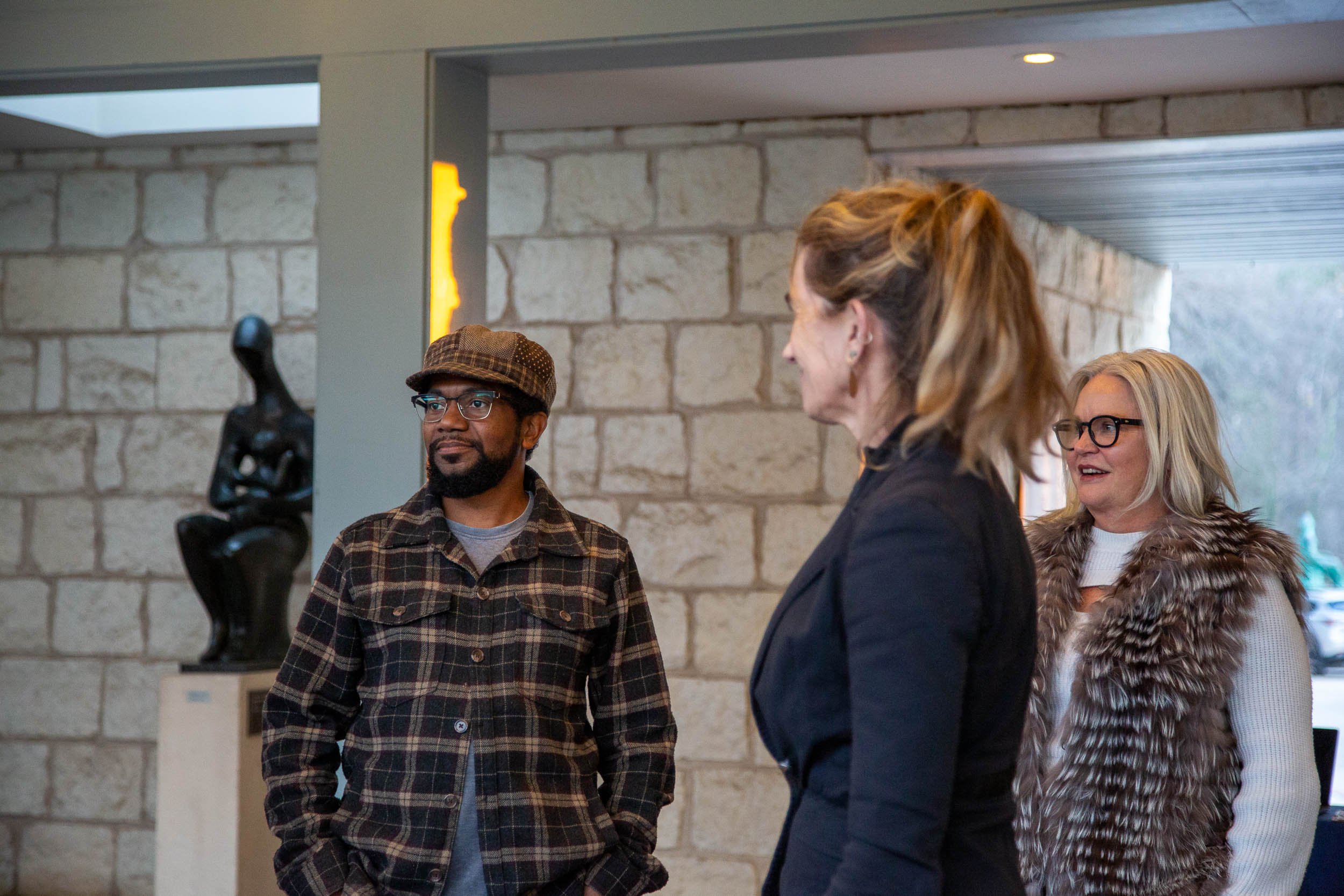
Huckaby, a Fort Worth native and longtime professor at UT-Arlington, made his name creating massive, mural-sized paintings with thick paint, heavily applied to create a textured, three-dimensional feel. His sculptural work, less known, is the center of the exhibit.
He worked with friends and family of late Dallas County District Attorney Craig Watkins, the first Black DA in Texas, to create a life-size sculpture of the man following his death in 2023. Watkins founded Dallas’ Conviction Integrity Unit, which reviews closed cases and has contributed to the release and exoneration of dozens of wrongfully convicted people. More than thirty were freed during Watkins’ own tenure. Huckaby drew charcoal portraits of 24 of these men, layering them atop manila envelopes and case documents, and mounted them behind Watkins’ likeness. Huckaby had to work hard to find reference photos for these men, many of whom didn’t have public photos outside of their mugshots, some of whom had changed their names after their release.
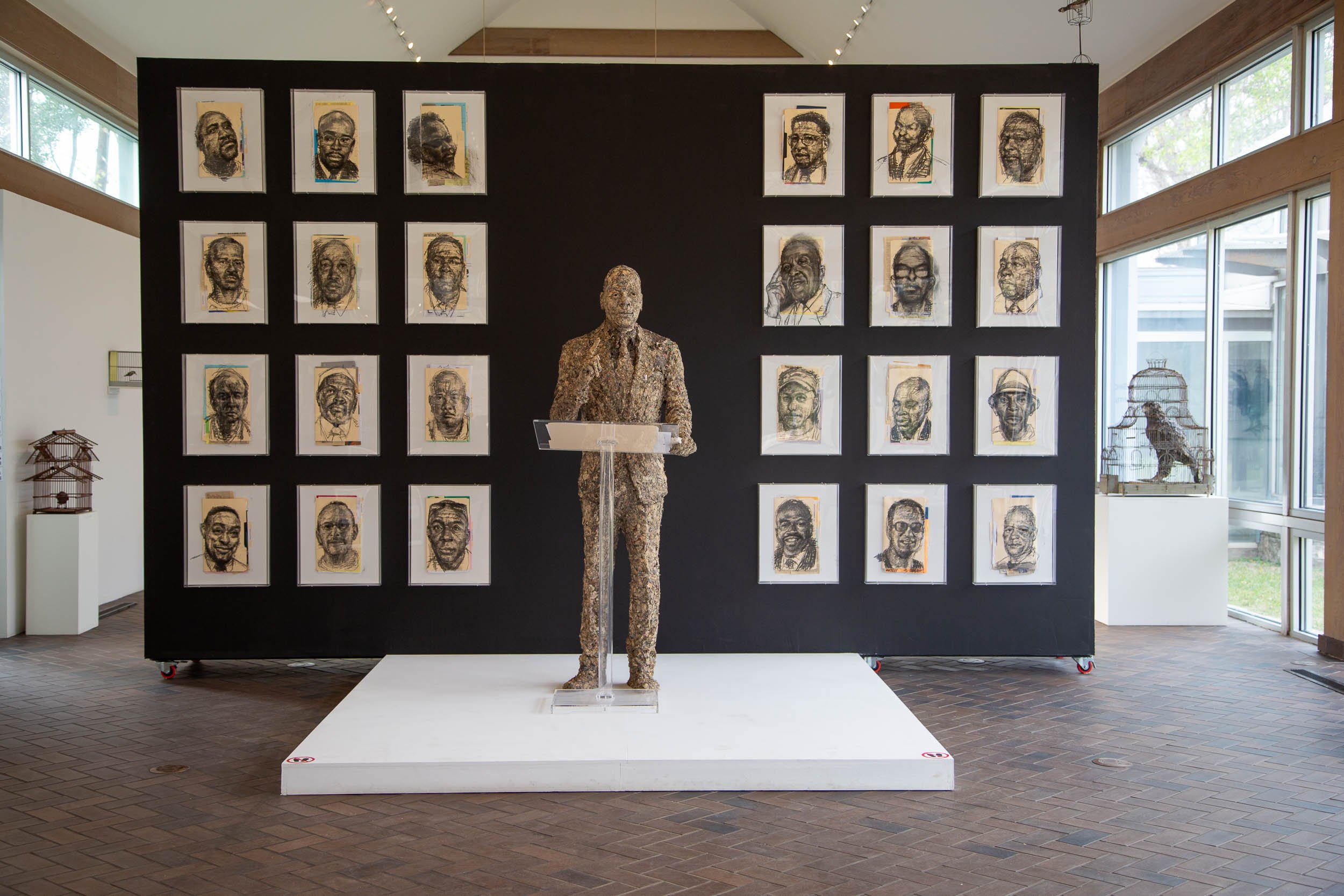
Watkins’ sculpture is made of issues of the Dallas Morning News and Fort Worth Star-Telegram, hometown papers for the former DA and the artist. UMLAUF executive director and curator Katie Robinson Edwards said his charcoal portraits carry another layer of meaning, too. “Charcoal is actually burnt wood, so also kind of a medium that has a lot of history. But it’s also pretty flaky and it can be erased,” Robinson Edwards said. “And to me, erasure is a huge part of the show—stories that are impermanent.”
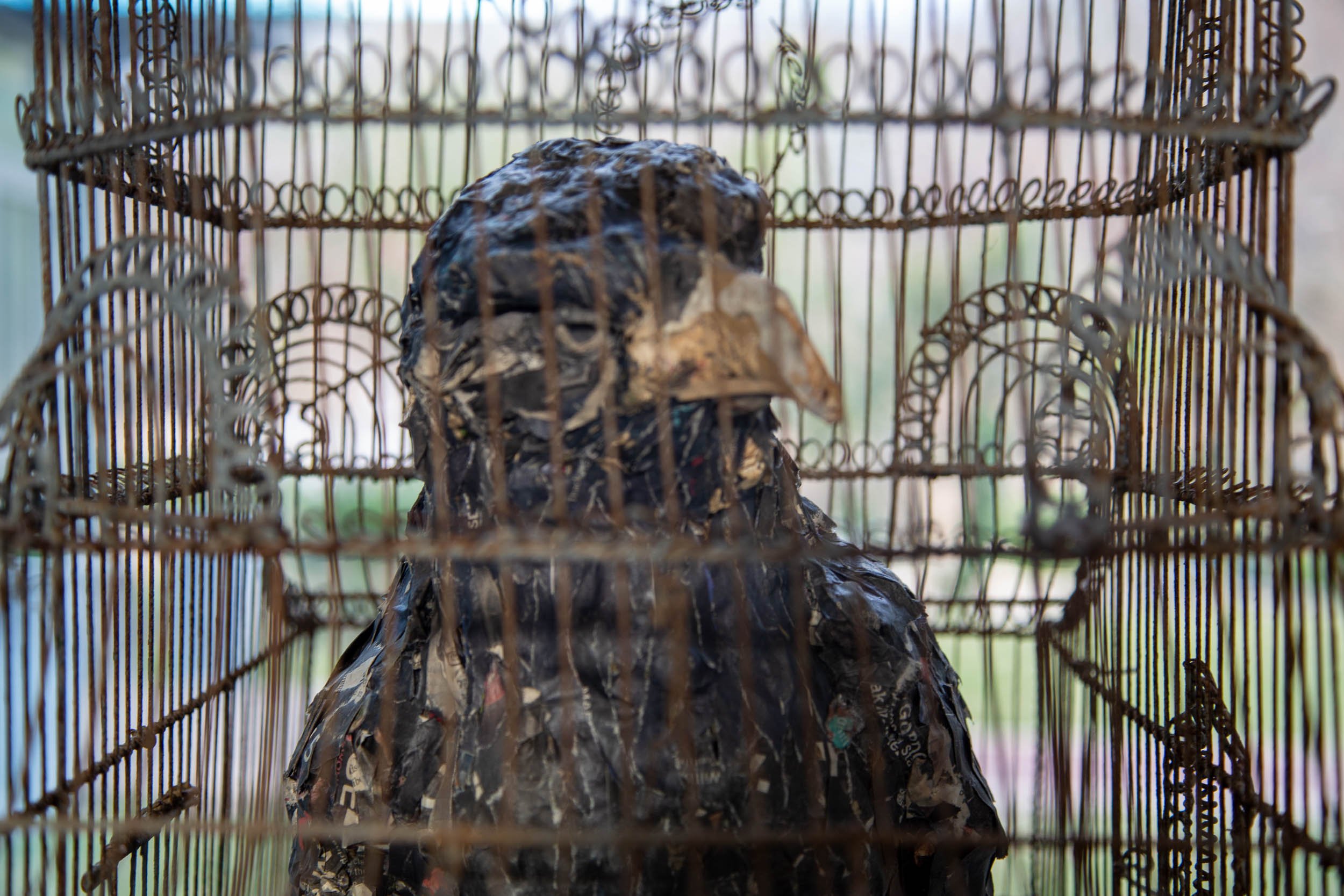
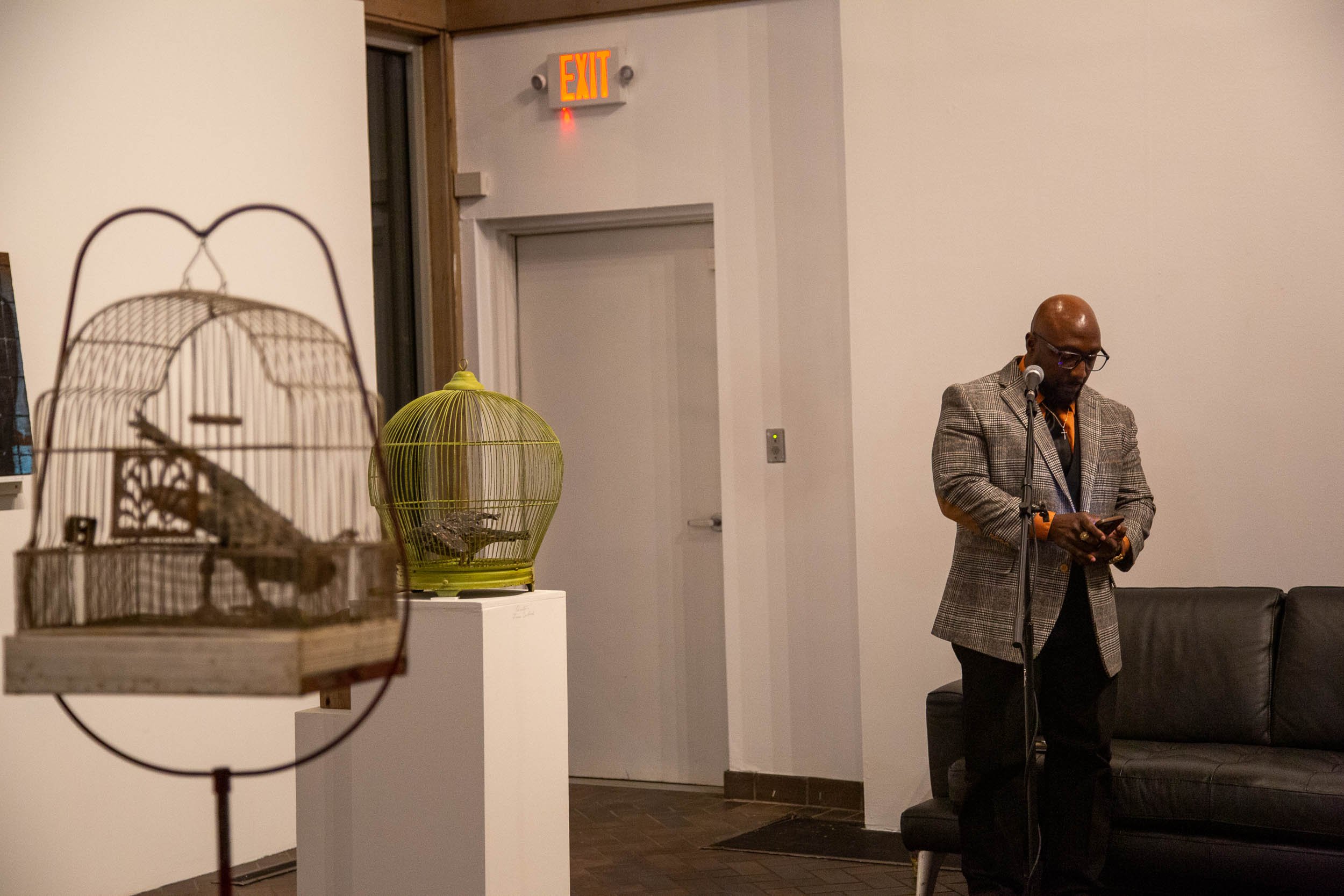
The exhibition gets its name from a collection of paintings and of papier-mâché birds, which Huckaby arranged in undersized vintage cages. Each bird has a name, based on someone Huckaby knows: Antwon the black vulture, Big John the northwestern crow, Shaniqua the black drongo. Many are mid-motion, but all seem to strain against their confinement.
The emotional heart of the exhibition is the most unexpected piece. Two short videos play on a loop in the corner, showing Huckaby creating large portraits in charcoal, smudging them, and then drawing new ones on top of the blurred background.
The first video, “Contemplating Fred Rouse,” was inspired by Fort Worth’s only known Black lynching victim. Rouse was a butcher who was brutally beaten by members of a whites-only union after crossing a picket line at a Fort Worth packinghouse. Five days later, on December 11, 1921, he was kidnapped from his hospital room and hanged on Samuels Avenue.
There were no existing photos of Rouse, so Huckaby experimented with how he might have looked. He based these interpretations on people he, Huckaby, knew, ending the video by drawing his own son’s face.
The second video wasn’t part of his initial plan. It came about when, through hometown connections in Fort Worth, he connected with Rouse’s grandson, Fred Rouse III. The younger Rouse wasn’t aware of his grandfather’s story until 2020. He had no idea that his grandfather and namesake was lynched in the city he called home. He’s become a community activist in the years since, founding the Fred Rouse Foundation and leading the Tarrant County Coalition for Peace and Justice.
“After meeting this man, I said, ‘I’ve got to redo that piece,’” Huckaby said.
He set to work on a sequel to the first video, now armed with photos of Rouse III’s father, Fred Rouse Jr., and his son, Fred Rouse IV. Huckaby created another video, this one titled “Portrait of Fred Rouse.” A cover of Sam Cooke’s “A Change Is Gonna Come” plays with the video, sung by Rouse III himself.
“It’s just about dealing with the things around me that I think are important,” Huckaby said, “and eventually, what I discover is that those same things that are important to your family and your community are important regionally, nationally, even internationally.”
The post ‘Black Bird Redemption Song’: A Fort Worth Artist’s Work on Confinement, Freedom, and Fred Rouse appeared first on The Texas Observer.

Want more insights? Join Working Title - our career elevating newsletter and get the future of work delivered weekly.
